Photobucket

June 5, 2007

Anniversary

Walk Away

"Sometimes I see it less as us having fallen into the same trench, and more as though, with sword drawn, I was backed into a corner, cutting and slashing more furiously, abandonding strategy and now throwing the blade around in a fit of frenzy hoping that all it cut would die, with no hope of victory but only the last bit of rage before I became exhausted.

Somewhere in the heat of it I backed into you. I saw that you had indeed been forced into the same corner. And were winning your battle. It makes me want to fight harder. I just can't tell if it's from inspiration or jealousy.

I want our moments together to tender. I want to be your refuge, if only for a while. And you're right. Thats the way it has to be. You can't turn your back on your enemy to help me, or they'll get us both. Nor can I turn and fight yours, I've been fighting mine much too long - it would be an insult to myself.

So let our moments be the space where we realize that a sword through your chest is the same sword through my back. Let us stand back to back and occasionally shout out loud words of love to each other over the horns and drums of the enemy all around -

have faith in the Republic of Texas..."


While we were busy playing video games and dreaming of better colors to paint the walls, life happened over and around us. While we rode parabolic waves between bouts of sudden fortune and dinners out versus wastrel-thin meals and bitter indignities of employment, our time together was gathering, commenting, dissolving about and within us. While we argued whether it was the poor or the rich that deserved to be cooked and eaten, while we ignored problems and committed secret indiscretions, while we flourished in public and in private even during the times we seemed determined to escape each other, time seethed beneath our feet like a rug pulled out from under us. All this flying may have been falling for all we know.

Last week I thought with dread that I'd missed it, that I forgot to remember it, neglected to properly appreciate our victories or archive them so that I wouldn't have passed in and then out of the longest and best relationship I'd ever co-starred in and be left with no evidence. I should have taken your picture every week. I should have opened my eyes wider, talked less, absorbed more. How can a body make these decisions in the present tense? I'm riding a sled down a tilted plane, sanding my heels to the bone trying to brake so that there is more to the ride than the point I embarked from and the point I arrive at. I want to know where I was in between, all of those half-seconds at high speed. They were the happiest half-seconds of my life, I want to at least know where I was when I had them.

But that's the lie of a wounded mind. In reality, I forgot and neglected nothing. We have always been more bare and less blind than most couples, we make preposterous, impossible decisions as casually as others order Chinese food. If there was love or blood or bile to be wrung out of those days, we sprained our forearms doing it. We blew through assailants with blades blazing, but dressed each other's wounds by night, and each inspired the epic poetry the other wrote on his sabbaticals and solo missions. The sad truth is that there is nothing you can do to remember better, to make those moments last as anything but echoes. Without a physical tie to the mythological, a tooth or some scrap of hide or horn, you will never quite believe what it was that you hunted all those years, and even then you grow to worship the artifact, not the beast.

You wrote this letter to me after we'd known each other four months. It is a testament to our indefatiguable stubbornness, if not our love, that it could have just as easily been written now, four years later. As long as you remember that Arizona was one of the last territories to be settled into statehood, and I keep in mind that there are factions in Texas that are still lobbying to secede, we can hopefully still meet in this corner from time to time and lay waste to hours and enemies alike.

May 27, 2007

Montauk Is For Lovers

Hotel Bed Jumping Hotel Bed Jumping II


We are a motel manager's worst nightmare. Everything you need to know about my trip to Montauk is summed up in these two pictures.

Okay, if you really must know more, then suffice to say that I'm fantastically lucky to have any family around whatsoever this far from home, but even luckier that it's someone as adventurous as Kelly, who...

♥ ...When I invited her to come with me on this trip on short notice, said yes before she even knew where Montauk was. Actually, I'm not even sure she knows now. It's the ass end of Long Island, the island which Brooklyn and Queens are on the complete opposite side of. Actually, it probably makes more sense if our end is the ass.

♥ ...Agreed to spend a chunk of the trip bicycling and invest in a rental, even though she hasn't ridden a bike ever since she got pretty enough for guys to begin driving her around everywhere. And whom intrepidly took to the road with a fearlessness natural to one who has cheated death or at least fallen on one's head many, many times.

♥ ...Does not get one bit as cranky as she used to, even when it becomes so obvious that we are trapped in our motel room for the night without any food or beverages that she threatens to drink her face moisturizer.

♥ ...Will brave the cold winds and crossing the highway on foot (while wasted) in order to buy me the best coffee-flavored malt I've ever had, bare minutes before the last open purveyor of refreshment closes for the night, and whom afterward will barely even bother to taste the fruits of this expedition, even though it's the best thing I've ever engulfed and I could do little but sit and concentrate on relishing it for ten full minutes.

♥ ...Will scramble up somebody's private driveway without hesitation if it means getting a closer look at a deer.

♥ ...Will inform, and not judge, my daytime-TV as nighttime viewing-options during our after-hours imprisonment at the Sands Motel.

♥ ...Answered a morning "how are you?" with, "I feel like I was gang-raped. But it was probably just all the bike riding."

♥ ...Can somehow manage to fully explain the rules for "Crazy Eights" but forget to mention even once what eights have to do with any of it.

♥ ...Was totally freaked out by the tiny crabs we found while digging our sand castle and refuses to touch them, but had no problem building a pit in the castle's center where we can house them to devour our enemies for sport.
...Will confirm for me that yes, that IS Molly Shannon who just came into the diner we're having breakfast at, and who will also stop me from being a huge freak about it.

May 13, 2007

Compound Eye

The Surface of the Water

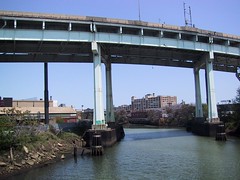
My collection of Newtown Creek photos has gotten so extensive that I decided to map them. This is for my benefit as well as yours-- it's getting hard for me to keep track of where I've been and where I've yet to go. Click on the oil-slick above to check out the map!

I don't exactly understand the magnetic yank that's pulling me toward the creek these days; I'm sure most people are already sick of hearing about it. Perhaps my desert upbringing has imbued me with a natural craving for bodies of water; perhaps it's my fascination with disaster and wreckage; or maybe it's just my simple tendency to drift toward places that afford the most privacy-- and for solitude, nothing beats these creekside trashscapes. It's all of these reasons, I suppose, plus the one that I'm not allowed to tell you, the one that fades like a dream unless I'm actually there, sitting on a shelf carved out of rock by centuries of failed optimism. You know that reason well, it has a footprint in all of us, deep enough to fill with water when it rains. So it has been during these wet months; I am overfilled and underfed, and I can't see the bottom of the moments I'm stepping over.

When I was young and first began my search for someone to love, I sought out places where only someone like me would go; my logic was that if one spent enough time in such a place, sooner or later someone else would arrive who would be instantly recognizable as the answer to my silent question. This led to my spending lots of time in lots of really questionable places, as well as lots of disillusionizing false positives-- it turns out my own tastes weren't so esoteric after all, and there were always plenty of creatures there doing the same thing I was, looking around at each other in unhealthy anticipation and whipping their heads around each time someone new entered the room. And at the end of the night everyone winds up compromising their vision a little bit, with chemical assistance if necessary, in order to go home feeling like they got just what they wanted, whether or not they actually get anything at all.

You can learn to stop using solitude as a lure to capture company, but you have to hunt something or you'll starve. I suggest you go out in search of imaginary creatures. There are many: the famous cryptids such as the Basilisk and the Hoop-Snake, the Skunk Ape and the Jersey Devil, with their historical sightings and campfire tales. Stories are meant to be shared, but they are born in isolation-- the howl in the woods that no one else was there to hear, that inexplicable footprint. And belief in them, or in anything, is something that never happens to you when there are people around to share it. You return to the world with your hackles raised, or with your heart drenched with awe, and you can infect people with your vision, but you can't give them the piece of yourself that was there, that knows.

Suffice to say, when I meet other humans on my trips to the city's bare edges, I no longer wonder whether it's a fateful encounter. I'm hunting larger game, so I assume they are too. Sometimes it's me they're hunting, as security guards are pretty touchy about people snooping around these areas taking pictures of bridges and waterworks and the like. And when I'm in that state, reduced to an eye zipping around at the speed of bicycle, I don't always have the capacity to remember the right answers a citizen ought to provide when asked questions about touchy subjects. I have no name, I have no business, and I have no excuses. Good day, gentlemen. The other hunters are usually can-pickers, committed industrialists, immigrant laborers, and their children. The occasional Greek chorus of testy grey gulls. Butterflies. Cats make up a significant number of the non-cryptozoological creatures that these out-of-bounds areas have to offer. New York City is home to tens of thousands of feral cats, and I run into them everywhere.

Today as I leaned over the guardrail of a lesser bridge crossing Dutch Kills to take this photo, I suddenly found myself face to face with a coot and a Great Egret preening together in the muck below. Whoever capitalized one of these birds and not the other certainly knew what they were doing; the Egret looked like music pressed into flesh and its body moved like a pennant, over three feet long but weightless and unpretentious. It was twenty feet away, but through my camera you could barely tell what it was. Almost unconsciously I climbed over the guardrail and scanned the embankment for a place to scramble down to get a closer shot. I was just letting go of the railing when two things happened: first, the bird shook its wings and flew away like the details of a dream, and second, a NYFD patrol SUV pulled up to the curb behind me. I admit, it looked bad. To his credit, the officer didn't outright ask me whether I was thinking of jumping. "What are you looking at?" he asked me. "There was... a bird," I said lamely. "A really big bird, a crane or something. I wanted to take a picture." He and the fellow in the passenger seat glanced beyond me just enough to see that there was clearly no such bird in sight, and exchanged a look. "Just try not to fall in, okay?" Having served and protected me to the extent they could, they left. I could see the Egret bathing further down the creek, mythologically out of reach. I don't believe in every experience being mediated through photographs, but I felt genuine loss knowing that without having gotten the picture, I'd never be able to prove what I'd seen to anyone, not even myself. Those few seconds hadn't been enough, the great bird was already fading from my vision like the spots you see after you look at the sun.

I'm hunting that myth. Not the Egret, not the sudden love of familiar strangers. Not the Roc or the Mngwa, or at least not exactly. It's the impossible reality of a populated privacy that I'm after, a skin stretched over the known world that gives thoughts a safe place to manifest unchecked. The deeper I reach into it, the harder it is to come back with anything but photographs; everything that happens to me there is somehow more real than the scrapes I have on my elbows and back when I get home. If you want to know what fastens this world together, and how to dismantle it if necessary, you'll either have to search for fault lines of your own, or else meet me at the middle of the Pulaski Bridge, where Abby's goblins have laid out their trash-bag traps so they can feed on human garbage, and we can roam the shore together, alone.

End of the Line

May 12, 2007

Chriskadecaphobia: the fear of thirteen Chris Kellys

Storm Drain II

Yesterday evening spontaneously turned into an opportunity to photographically ensnare Chris Kelly, from which all parties emerged satisfied. Check out the photos here.

May 8, 2007

One Day In Pictures


Some days it just doesn't go your way, and even then the world isn't shy about letting you know that it could get worse any second.

All of my plans have changed within the last few days. Everything I know about where I live and who I love is different. This summer, when I find myself with a bed and a room to myself for the first time in years, I will be thinking about today and wondering at how crowded and pregnant my life used to seem. I try to imagine that future self as having drawn some very important conclusions about all this, though I know that even by then my great experiment will be just beginning.

This Property Is Condemned

I visited my old house today, to pick up a delivery that had been sent to the old address by mistake. Every block I traveled down Graham avenue was like having a blanket pulled up around me another few inches. Nostalgia is treacherous, but I needed to bed down with an enemy today, needed evidence of my climb so that I would feel a little better about slipping.

The graffiti I left on the building two years ago was a familiar face of sorts, one I'm glad to finally have gotten a picture of. When we'd moved in there was a big sign on the wall that said POISON, warning people away from the rat traps. The sign fell down eventually, so I decided to take up the cause. If anyone ever noticed, they never said anything. It seems as if I've worked on so many little things that required tremendous effort, but were by definition meant to be abandoned. Often they wind up lasting longer than anything else in my life, turning up in odd places long forgotten.

Hannah and I took advantage of the 2003 blackout by painting graffiti on the much-decorated warehouses near the East River, working in total invisibility. I looked for it today on my way to the water, but it's all gone already, lost to salt mists and raw winds. You can choose what you do but you can't choose what stays done. I return to the same spots by the river at different times of day, in different seasons, always searching for new features but also visiting the part of my history that slips further into the water each year. The concrete ledge where we spent that night of the blackout under the obscenely full moon with so many other drinkers and lovers and apocalypse junkies is gone now, it slants at 45 degrees straight into the water like a slide, which it would be if you sat on it, since the surface has been slicked with a bright coat of green slime.

How many times can a person take the same picture? I know the eastern edge of Manhattan by heart now, I could draw it from heart. I could describe it to someone so well that they could draw it. Today my life was new, today I was being pulled out of retrograde and sent forward into action, whether my heart or my environment could bear the strain. So where were my new visions, and how would I know them when I saw them? The glass crunched under my feet as I paced. And then I found them, my new heroes. Click to enlarge, they're worth a closer look:

Rise Sprouts Snowflakes In Green and Glass

Describing these in words would be redundant, their power is in what they are and what they are doing so simply, gently turning over the blades and taking what they need from everything around them. It was while I was scrambling to take these pictures that I found another hero, another loss, another instance of permanent ephemera that had blended in among the garbage piled high by the fence.

Laura's Letter

"In memory of my friend Sandy & her lover.

Sandy and her lover drowned in these waters on January 31, 1986

Sandy accidentally backed a vehicle into the water off of the pier. Her lover died trying to save her.

Sandy was free spirited, young, beautiful, talented and a loyal friend. I wish I would have had a chance to tell her that I love her before she died.

Sandy, I miss you and think of you all the time.

Love, Laura"

I looked at the joint where the concrete buckled just beyond the fence, trying to imagine what had been there before, finding it impossible to visualize the scene that Laura's letter described. Finding small improvised shrines and monuments is common in the city, I see them everywhere, but here? So far out of the way, where only the most curious or lost person might notice it? The letter was sheathed in plastic, but I could see moisture bubbling up beneath it. Despite the effort put into preserving this message, after another week in this warm weather I'd never have been able to read it. January 31, 1986. I thought of the icy water, the distance of the nearest telephone, the lover, who I imagine to be a woman, diving and diving until the cold overruled her frenzy and she couldn't tell anymore whether her limbs were moving. That was over twenty years ago.

Laura's Flowers


I think that I am going to always be the same. I think that in twenty years I will return to this place, to all my places, over and over again. I hope that I will be able to scatter elements of these places in other places, leaving biblical omens and chintzy souvenirs and letters to the dead in places where they are likely to be found by the curious or desperate or casually interested. But for now I would like to think that I can tell when the story that most deserves to be told is not my own (which is still being dreamed and drafted). And on the days like today when it hurts to wake up and the sky is practically too blue to tolerate, it's a relief to refuse the option of rising to that occasion. Not every day or every year gives you your own story to tell, or someone to tell it to. In the lean times the stories that blow in with the dust, sprout under garbage, or are left taped to the fenceposts, will be enough to sustain you.

May 3, 2007

The End of Literature

Hologram


Woke from a dry sleep, careful not to rustle the pages as I lay there. You slept between 204 and 205 that night. I was between 200 and 201. We meet at the binding while we dream and eat through the paper like mites until our blind mouths sink into each other's. Fresh pages every few days. The spine is cracked from being laid open for so long. I can never remember to pick up my clothes.

Literature, dismayed by rumors of new storytellers that feed while sleeping and feel no hunger by day, feels obliged to uninvent itself. History rolls backward, stuffing jewels back into the mouths of our heroes, putting their hats on backwards and reminding them of their worried families and overdue bills. They are dismissed. Kisses run under fingers like Braille and race up the arms, reaching mouths but never eyes or ears, lovers gasp at the mental rockets but exhale nothing, glowing like cast-iron stoves packed hot, so perfectly hot that there is no exhaust ever, just more heat. More and more.

Speculation flies through the headlines, reinforced by omens and market trends. Global economies become obsessed with their own thoughts, and explode. Pilots point their planes at the earth for a full two minutes during each flight in an effort to unite people in wordless expiation. Ticket prices soar; people pay them. Certain products are discontinued and not missed: sunscreen, dental floss, vitamins. And books.

Books are still made but they have evolved. Not into flickering words on electronic paperscreens, but into something between a wedding cake and a letter-bomb. Thickly frosted, with pockets of dye or liqueur that will occasionally rupture and run down the wrists, staining clothes. Fold out panels of spun sugar printed with India ink, the creases laden with pollen and freeze-dried berries ground into a fine powder that stops up the throat in a spasm of wet thunder. Compressed air that suddenly sprays from a concealed jet in the binding and cools the brow so that one can smell the frakincense and cholera that's rubbed off onto one's fingertips. Unexplained flashes of heat or creamy smoke as tripwires taped between pages are pulled loose. Bindings of all shapes, with textures and grooves made to be coveted between the breasts or taken into or against oneself, figurines embedded into illustrations, radium alloy airbrushed onto their marzipan shells. A concerto within a witch's gingerbread house within an epic novel within a faberge egg. Each new volume practically oozes out of its box when delivered, like fresh fish in a newspaper. Its pages akimbo and its letters marching like ants, running like mercury, the cover sticking to fingers and its innards recondite with impossible flavors illustrating facts mined from the collective heart of living-- or from the void-- it promises a digital transfer of information to the brain, by way of heart, by way of stomach.

The first books made exclusively of edible components inspired unrest and a sort of audible sighing above the cities as the waiting began. We weren't satisfied anymore, you see. We needed to be able to take in all of it. The importance of words was eclipsed by the need for communion, for intercourse and physical transmutation, over and over again. We wanted to tattoo our organs with the things we knew, and sought creative ways to swallow the needle. The new books have come, and we, the ruminant, can feel our clockwork hitching and galloping to accomodate the strange mass, our mechanisms busting their teeth on the indigestible and incandescent compost seeded with suprahuman utterances and spongiform manifestos scattering through the body like dandelion parachutes. We excrete the paint and lithium battery-cases while our cells feed and our faces shine, but there is no name for it, and nothing to discuss. One book at a time per person, no sharing, so that we cannot continue life's illusion that anything is actually shared, nor tell if we are awake or asleep together, or whether we are making love. The world is something that happens inside each of us. Each person, every man and woman, is a star.

Together you and I broke apart our furniture to make room for the new hardware. The new models were bound in leather and velvet, with scallops sawn into their edges so that one could grip them for leverage while turning the heavy pages. The words printed in these stiff oversized texts were not meant to comfort or inspire-- we are inflated from within to the limit of our seams and have no use for these alphabetic overtures typed by the spidery fingers of machines. Having embedded whole libraries into ourselves, however, the appeal of becoming ourselves embedded became almost unbearable. The larger models were unfathomably expensive, but the ads ignited the public's imagination and with our post-human eyes we all sought to build our castles in miniature, a slim volume of Blake-ean verse writ large, perhaps, just large enough to house a couple or two. The immense pages curl over me like a shell at night, the smell is hermetic and clean. We squander in sleep what our ancestors spent their lives searching for: a feast, an idea, an other.

There is no such thing anymore as together, or alone. We have survived the death of clever. The death of ability. We have survived the death of magic by building a house from its bones. In the morning, when the sun shines through the heavy paper over my face (in transparent gold coins where my sweat has bled into it) I can see the letters from both its sides inked above me forward and backward. I hear someone, maybe you, turn over between other pages, in another chapter, and I smile at the words overhead. They are meaningless. They are embellishments that cannot describe the themes in my life or universalize my experience. They can not arouse me or read the future in my entrails. I brush the pulp from my papercut lips and sit up in bed, waiting for you to wake up.

May 1, 2007

Wiley Rides Again


Having been recently laid low after his appendix was deemed expendable, my friend Wiley asked if I would take a triumphant photo of him for his birthday invitation to show that he wasn't licked. As it turns out, the artist who made Wylie's T-shirt liked the image so much it's now up on her site. Check out her other shirts as well, they're pretty classy.


(Other shots of Wiley looking superheroic)

April 29, 2007

Impossible Trees

Springtime

Spring is the only time of year when it is safe to treasure everything, even the profane. Our devotion spends like money, and by the end of the year we have just enough to keep ourselves and our families warm; in the early months it spends in streamers and runs out of pockets like sand. The exuberance is a survival mechanism-- this mad old world has to grow higher and higher each year to unbury itself from the last's revelry and waste, and so the trees are a little bit taller than they ever thought possible, and we stay up later than is wise, just to hold our ground.

Impossible Trees

Every year around this time I feel like an impossible tree, growing downward instead of upward. Tunneling down with roots, stretching back through the layers of dead years so that I can soak up all I can from them, sinking experimental taproots below what I have any business remembering, touching the faces of my ancestors with blind fingers with the vain hope that when these sensations reach the surface, they will inform my growth in a way that mere sun and wind can't.

Buds

Over time, this misdirection of energy has left me struggling to breach the crust anymore: a few fretful limbs straining, spurting out disturbingly bright blossoms from the ends like distress signals. My bones are here in the sun, while my heart and my canopy of nerves swell and infiltrate below, buckling sidewalks and laying claim to the city beneath the city. It's frightening to me how fast the world around you can grow up over your head and retire you once and for all among only those of a certain kind, from a certain time or place. Or how a reflection can become so alluring that one never strays beyond the eye of a mirror. If ever there was a time to push myself up and out of what is knowable and concrete, it is now.

Eights

These walks, where no one is watching, through places where neglect has been hard at work replacing civilization with nightmares, and those nightmares with soft consoling green fingers. These dreams, in which I travel every night from state to state, from home to home, passing out pieces of myself to people that are just sketches of loved ones real and imagined; from which I sometimes awake in helpless tears. These landscapes which seem imaginary until one day when I find myself spontaneously taking a new route home and accidentally arrive at the last human outpost before the mouth of space swallows up the world. These places of smirking solitude, where helplessness is discovered to be power, are my new territory. I have paid my dues to the underworld, and there is nowhere left to go but up, and out.

Kingsland

April 25, 2007

On Vision and Visibility

5 years old

When I was a child I didn’t know I had lost my sight until someone told me. My first grade teacher, Mrs. Hernandez, sent a note to my mother to say I was squinting in class. We three met during lunch the next day; Mrs. Henderson wrote a sentence on the blackboard and asked me to read it out loud. I complied, knowing that some sort of test was taking place and determined to pass it. Then she asked me to stand at the back of the classroom and read it again. Without a trace of a squint I recited the sentence, which I’d quickly memorized. I was convinced I’d passed with flying colors; Mrs. Hernandez made a sour face and wrote a new sentence, challenging me to read it from where I stood. It was the first test I ever failed.

The following week, when I returned to school with my thick glasses in grey plastic frames, it didn’t take long for me to realize that the whole world had shifted to accommodate this failure. On the playground I showed off my new glasses; I had been taught that they were expensive and important. “I get to wear glasses now,” I told two boys from my class. A quick glance between them was all the social permission needed to proceed with the inevitable: “FOUR EYES!” I fled to Mrs. Hernandez and complained that the boys were making fun of my glasses. “You’re the one who brought attention to them,” she said with sublime indifference, “If you don’t want people to make fun of them, then you have to stop bringing them up.” Another test failed, in as many weeks: first vision, then visibility.

My vision degraded slowly throughout grade school, and with it, my interest in the world that school presented. How could I be expected to take the torment of mathematics seriously when all I needed to do was take off my glasses to make them disappear? Without the glasses there were no straight lines or horizons at all. Edges mingled in a foam of colors, erasing the angles and textures from anything further than an arm’s length away. The tiniest points of light refracted into spectral globes that were indistinguishable from larger, closer lights. And how could I be expected to value friends and companions? With a single motion I could render them all identically featureless. The only body parts close enough to seem real to me without glasses were my own, which my myopia magnified like a low-power microscope. Reading without them was a morbid luxury: the bare inches between my face and the pages allowed me to bond with books on a molecular level, and barred any rivals for my attention.

Nature saws away at us before we even know the value of what we’re losing, and sometimes all one can do is merrily join in the brigade, leveling and deforesting in hopes of exposing whatever truth may lay underneath the canopy of rich growth. That’s an understandable human instinct, but it crosses the line into pathology when, upon surveying the barren rubble one is left with after this process, one takes up a pre-emptive belief in the evil of trees. And so, they could make me go to school, but they couldn’t make me see. I kept my face down, secretly reading the book in my lap, I filled one notebook after another with stream-of-consciousness drawings, and when all else failed, I would take off the glasses and sit up brightly in my chair and pretend to be no different than anyone else. It was my favorite form of rebellion: without the clunky glasses drawing attention to my face, I became invisible.

By eighth grade, under heavy scrutiny due to falling grades, I began to panic. I was too far behind to catch up, but unprepared to fathom the very real consequences of true failure. The strain was crushing. At least once a week I would wake in the night with severe abdominal pains that kept me up until dawn. In the early hours of most school days I would feel acid gnawing at my stomach lining, and would ask to be excused to the nurse with sulfurous fumes rising in my throat. Doctors told my mother that they couldn’t find a medical cause, and so eventually this complaint alone couldn’t be counted on to get her to take me out of school. I tried to protest that my condition was genuine, but I couldn’t take any argument too far without revealing that while I wasn’t faking my sickness, I was in fact faking my life, and so both continued unchecked.

I changed my strategy, and once more, blindness became my escape. One day, with acid lapping at my insides and a math test three hours off, I bent my glasses in half at the nosepiece and twisted them into wire wreckage. It was terrifying to watch my hands perform this act upon the expensive, important property my parents had entrusted me with. Even so, I didn’t care whether they would ever be fixed or replaced, I was too relieved in the knowledge that I had just bought myself at least one more day of peace. In fact, glasses were delicate objects; I didn’t see why this sort of thing didn’t happen more often. Perhaps now it would.

The nurse communicated the report to my mother that someone had stepped on my glasses while I was showering after P.E., and I was picked up in a flash. However, the thrill of discovering the panacea to my problems was short-lived. Mom had been able to secure an immediate appointment at the optometrist, and I got to sit and watch the ease with which the kinks were ironed out of my handiwork. As she drove me back to school, I scrambled to think of delays to inject into our trip, but was afraid to seem too desperate. As I entered my math class with a note—only ten minutes late—I felt the lid of a jar sealing itself tight overhead, sucking the air out of the room. There was no other way out that wasn’t more frightening and violent that what I had already tried. Against my will, and years after I was meant to, I began to consider life as an option.

Over time I made it more and more difficult to escape into that sightless world, as an act of self-preservation. Not long after I injured my glasses, my mom agreed that a graduation to contact lenses was in order; I started high school with clear naïve eyes of a beginner, the way I did in first grade. To this day my eyes are capped off with contacts that I’m able to sleep in if I want to, and technology has improved at a rate that will soon make me a candidate for surgery to permanently correct this flesh-failure of mine. Often days go by without my remembering that this difference exists at all, or ever existed, though it’s still all there, under the plastic sheathes, in physical memory.

In my dreams I often find myself unable to see, as if I have lost my glasses. It’s a detail that makes my dreams especially vivid, and it is strange to think that one day these dreams (and my unforgiving school records) will be the only traces left of the first draft of my life. It’s clear I’m better off this way; my fetish for reality-negation has been channeled into a functional lifestyle, with full participation in this world on a creative level, complemented by meditation and writing as a way of actively terraforming the world beyond, that realm where I used to drift passively, smothered under the weight of my dreams. However, I still feel panic and grief at the thought of losing my blindness—somewhere along the way, my identity became inseparable from this burden and the secrets it taught me. Please don’t make fun of me for calling attention to it.

April 24, 2007

"Being enemies was better for my self-esteem than our friendship was."

Photo Sharing and Video Hosting at Photobucket


This is my contribution to SFUMATO, a webzine project I've been working on with friends. I'm fascinated by autobiography and storytelling, and I've spent too much time retelling all the stories my friends have told me about their own lives, so I finally decided to step back and let them to do it themselves. Enjoy!

Be sure to subscribe so that you don't miss the next installment, "FORBIDDEN LOVE".

Book Review

Published in Jason Louv's Ultraculture Journal One (2007):

2012: THE RETURN OF QUETZALCOATL (Tarcher, 2006)

Daniel Pinchbeck's 2012 is a continuation of the adventures he described in 2003's BREAKING OPEN THE HEAD. As a fan of that previous account of his "psychedelic journey into the heart of contemporary shamanism", I have been very curious to find out what Pinchbeck has been up to since his initation into the worlds of ayahusca, DMT, iboga, and psilocybin.

The first half sets a terrific pace. Though built on ideas and experiences that are more or less canonical and well-documented, it is thrilling to see them all lined up in order. Pinchbeck has done his homework and explores areas that many self-conscious psychonauts tend to avoid; for example, while lingering on the subject of crop-circles, he avoids trying to prove or disprove the phenomena and instead interprets our mass-rejection or mystification of them as a tender spot in our culture that exposes how tenaciously humans are clinging to an understanding of the universe that is unraveling out from under us. His vision of these last few years leading up to the end of the Mayan calendar—and life as we currently know it—is potent and infectious, and I began to make a list in my head of friends that I ought to lend this book to when I finished it.

However as the book marches on it becomes really evident that there are undeniable problems with not only his theories, but his motivations as well. The dissolution of his family life (due in no small part to the adventures he endures) coincides neatly with an impairment in his focus. While anyone with a magical bent to their thinking is able to appreciate the synchronicities and cosmic giggles that propel one forward through life, few people magnify those coincidences to global significance and apply them to the fates of everyone around them. Pinchbeck is honest about calling himself out when he senses his insecurity or baser instincts polluting his quest, and then his keen self-analysis eventually leads him back on track again. For every one of those moments, however, the reader will pick out two more in which Pinchbeck leaps from conclusion to conclusion with frighteningly subjective abandon, feats which no adept would ever perform without a firm grasp on oneself and one's limitations. That the ordeals resulting from this sloppiness ultimately lead to Pinchbeck's receiving a profound annunciation (from the great Quetzalcoatl itself) is cold comfort indeed: by the time this transmission occurs, the reader's head is likely to be so sore from repeated smackings that it can't possibly accept Pinchbeck's revelation as more authoritative than anything one might cook up on one's own, given enough bark-scrapings and jungle voyages. And by the time Pinchbeck begins handing over the bullhorn to prophets whom even he considers to be of dubious value, such as Dreamspell Calendar inventor José Arguilles, mental-health breaks between chapters become necessary.

With so many people in the world clamoring for Apocalypse, it can be hard to avoid playing that game. This book pulls you into it, at first calmly inviting you to play, then later begging and demanding that you finish what you started. There were many points where I had to put the book down for a couple of days so I could fairly weigh his ideas; his background matches my own in so many ways that it was easy to get swept up in agreement with his lyrical voice and his incredible citations from countless scientists, thinkers, and miscellaneous holy folks. But his book does not hold up to the level of scrutiny that he holds his role models to. In laying the book aside and trying to follow his arguments to their their logical conclusions, I found that they seemed dissolve without his voice there to energetically perpetuate them. I began to see this book, however bold and inspiring, as the product of a very neurotic and conflicted person. By the end, when Pinchbeck finds himself struggling to shake himself free from the influence of Santo Daime practitioners and New Age healers, his theorizing seems almost frantic. However I will say that my own worldview feels very sharpened by reading it—having to constantly dis- and reassemble my own philosophy before Pinchbeck's dark mirror was strenuous exercise that left me refreshed and exhausted.

I actually feel pretty concerned for the guy, because I believe the transmission he's been given by Quetzalcoatl is legitimate, and that his work is significant and enlightening, even ennobling-- to him. Unfortunately, being a writer, he is completely oriented toward broadcasting everything he thinks and experiences and projecting it onto the world at large, which leads to not only some grievous errors in literary judgment, but also inters him in a self-made prison of "prophecy". Without his ability and drive to write and deliver his prophecy to the masses teetering on the brink of Apocalypse, he'd probably be enjoying an incredible period of enlightenment. However, without the impulse to include and save us all somehow, I doubt he would have ever set out on this journey to begin with. Because of it, he experiences the most intimately documented magical breakdown I've ever come across. By the end of the book, at the point where he's hoping the reader will finally be prepared to absorb the significance of Quetzalcoatl's message, his words practically spasm on the page.

To offer contrast, not long afterward I re-read the end of Alan Moore's comic PROMETHEA. The last fifth of the series depicts the Apocalypse as a massive, inevitable unifying shift in consciousness, using artwork and fictional characters to illustrate almost exactly the same ideas that Pinchbeck delivers. I was struck by the differences. Despite drawing from many of the same paradigms and sources, the work of Moore's team is just plainly superior—more succinct, gentler, less subjective, and more challenging than frightening. It is also more persuasive and more believable, despite being embedded within a comic book. Moore makes the Apocalypse game seem like an unavoidable fact of existence in our modern world, but one that the individual is free to conceive of however they will; in addition, Moore lays out sketches of the Eastern and Western magical traditions, giving would-be voyagers a leg up in discovering original prophecies of their own. Pinchbeck starts out with the same idea, and for the first two hundred pages 2012 is authentic as only an autobiography can be, but as he presses on and his inexperience and insecurity begin to catch up with him, ultimately the only way he can reconcile them is to imagine that we are all in the same boat as he is—and it happens to be one where his help is needed to steer. With all due respect, I'd rather go over Niagara Falls in a barrel.

I'd still recommend Pinchbeck's first book to almost anyone, especially to those taking tentative steps toward exploring worlds just outside our own, but the second book seems only recommendable as a warning of what an individual will go through if one takes the path of initiation without having done the necessary work on oneself over a natural amount of time. I'm grateful to have read this, but I'll have reservations about picking up his next one—that is, if it turns out that they are still printing books in the years leading up to the great Arrival.

A mystic may swim through the same water that a madman drowns in, but if his connection to this world or to his will is not strong, then he will also be crushed by the same gravity that everyday human slobs effortlessly walk their tiny dogs through. In racing through a lifetime's worth of initiations in just eight years, this seems to me what Pinchbeck is running up against; in the closing of the book he leaves an uncertain image of what his life is now or what he plans to do with his hard-earned prophecy. He is as human an Apocalyptic prophet as one could dream up, a neurotic New Yorker struggling to stamp out willful ignorance and self-obsession on both a personal and global level.

April 22, 2007

A Corner of an Island

If you walk straight up Greenpoint Avenue, you trespass without meaning to.

First the neighborhood itself falls away and you find yourself touring a vast industrial complex, with half-built or half-demolished projects spilling out of their scaffoldings and yellow construction tape, physically barring your way. Then the road pushes up and out until you are at rooftop-level as you approach the bridge over Newtown Creek, the horizon widening until you are uncomfortably exposed, making even the dead immensity of the warehouse district behind you seem cozy. Crossing the creek marks your passage into Queens, but that's like saying that crossing the Rubicon merely takes you into Gaul; everything about this passage is forbidden, and as the speeding trucks shake the bridge under your feet, the water stares up at you like a dead green eye as you hurry across. Newtown Creek is one of the most polluted and neglected waterways in North America, and the neighborhood just beyond is redolent with its benzene-grimed influence. All of the buildings appear to be inhabited, and yet they all seem to be for sale. Finally, just when you think you must have walked into the very land of the dead itself, you turn a corner and find yourself looking up at Calvary Cemetery.

One Corner


The city is a great engine fueled by human energy, and when we're used up, we are expelled like exhaust into other boroughs, states, and islands. Queens alone has 29 cemeteries, housing over 5 million power cells, now drained. It's inevitable that this would cause cemeteries to abut other zones in interesting ways, but the sight of it is still always a strange surprise. Stroll along this sidewalk and you will know that the dead are suspended before you at eye-level, like fish in an aquarium.

No Dumping


Whether this seems respectful or even acceptable depends on whether you're standing on the sidewalk or the grass above. I've never walked through a lovelier cemetery than Calvary; its forest of obelisks and crosses blend in perfectly with the Manhattan skyline, and though centuries-old in some cases, the graves seem fiercely well-tended, as if the survivors are determined to make the most of the little scrap of land they've been given. And while the headstones are claustrophobically regemented in tight rows, it's practically luxurious compared to the cemeteries I've seen in Brooklyn, where you can only imagine that everyone's last wishes were for compliance with the gypsy tradition: "Bury me standing."

Skyline


In this city, there is no sacred place for anyone's rest, living or dead. We carry our own around inside us constantly, periodically finding a quiet place to set it down for a little while, a new neighborhood or new person becoming an annex that temporarily doubles our room to breathe, only to be torn down the moment we look away from it. We are palimpsestic. Far from discouraging, this pursuit beats redly with life's blood. We are closer to the dead and their world, and both sides glow from the attention. Our neighborhoods are side by side with theirs, we have no choice but to look and learn, to discover belief in things that make no sense, and if possible, plan an escape while we still breathe. Re-entering Greenpoint from Queens, scuttling back across the bridge and through zones that punctuate this space like the locks of a canal, I began to plan a picnic.

April 21, 2007

"The War Never Ends."

This motto was presented to me recently by a good friend. The letters were cut from tarot cards and rearranged, like a ransom note from a fortuneteller, onto the lid of a box of cigarettes. Cut-outs of images cover the rest of the box in a collage that reads like a complete tarot reading writ small. Inside the box are pages torn from the Book of Revelation, rolled and packed as individual cigarettes. Its weight is so light in my hand, but it is so dense with personal meaning that I can barely hold it. The little box is an entire potential conversation between he and I-- his tale describing his own last few months, his warning to me of what he fears my future holds, and a mutual appreciation of where our problems and dreams overlap. Except it's a conversation that we don't need to have, because it is sitting on my desk, asking me what I am going to do next.

Last night as I fell asleep I suddenly remembered that one day I would die. I return to this thought very frequently because it's one of those things that is indisputable though there is no trace of it at all in my everyday life. Yet. It is completely invisible, yet perfectly true, and whenever I remember it I am flooded with a feeling of incredible relief and gratitude. Because it means that one day, all of my questions will be answered one way or another. It doesn't even matter to me whether I am pleased by the answers, or whether I can guess them in advance. It is satisfying enough to simply know there is an end. I can fight playfully in this war of life, knowing that I can never truly be captured by my enemies.

That feeling is my contribution to the conversation hanging in the air around this little pack of cigarettes, and my response to it. The war never ends... but thankfully, I will.

The War Never Ends

March 27, 2007

Finding My Way Home

I dreamed you and I were visiting my great-grandmother and my great aunt. Or maybe your grandmother and aunt; it was hard to tell for sure. They had us stay in the guest room on the second floor. When I looked out the window I was stunned to see a lawn and flowers growing right beneath it; it turns out that the roof of the porch had been built with an embedded area for just that purpose. While it was an interesting garden, I saw that many of the plants were struggling or needed to be cut back or cleared away. I made a mental note to get to work on this; it was easier and safer for me, instead of my relatives, to do this treacherous roof work.

Our hosts were really big on making us comfortable-- cooking our meals and even asking if we wanted to go to the movies when it was rainy and boring. But we were very content to just hang around in their house, and I began to realize that there were lots of areas that were overrun with clutter, with knick-knacks books and junk having sort of spread out across the house over the years. One quiet afternoon I figured no one would mind if I rearranged things to make the space attractive and the house more liveable-- and also to make room for us to relax with the belongings we'd brought with us. It seemed we'd be staying for a while.

So first I began collecting all the little glass birds that perched on almost every surface and meticulously arranging them all in one place in a way that seemed lifelike. On an end table I found a strange antique, a horse's armored helmet made out of porcelain. When I lifted it up, I found that it was covering the head of a taxidermied white colt. The rest of the colt's body lay buried under clutter and old newspapers on the table Its hair came away in my hand, so I was very gentle with it; I realized that I must have found a shrine to someone's very beloved pet from ages ago. I rescued it from the clutter and set it up somewhere high where it would be protected. At first I worried that someone would come in and get upset with me for making all these changes in their house, but no one was home but us,and we seemed to have the place to ourselves for a while, so I kept going. Over time I could sense unmistakably that my work would be very much appreciated. I was taking care of things in a way that was necessary but that my family was too old or contented to do on their own.

There was a big oil painting standing neglected in one corner. In our room the window had no curtains, so I moved things and propped the huge painting in front of the window where the light would shine through and illuminate it. I noticed that all the other artwork on the walls-- prints and posters and my great-grandma's paintings-- had been sort of gracelessly, randomly hung many years ago, so I took them all down and began imagining better places for each of them so that they could actually be noticed and enjoyed for a change. You and I did this together. We spackled over the small holes left in the crumbling walls.

As I worked on these things, something suddenly became obvious. We weren't just visiting, our vacation had gone on for way too long for that; we had unconsciously moved in, and were here to stay. I realized that none of these relatives had been back in to check on us in a very long time. And even though it was full of their belongings instead of ours, the way in which we had redesigned and transformed everything within it made the house seem more ours than theirs. Looking around, the layout felt completely familiar to me. This room was my great-grandmother's living room. This room was my old bedroom at my dad's house. This room was my grandma Shirley's kitchen. Other rooms corresponded to your family and their homes, which felt familiar though I didn't recognize them. Their possessions and ours could not be told apart. The house was completely resurrected because of our influence as well as our deference to these old lives, and I felt a curious dual-sense of both accomplishment and awed humility.

And then I woke up to find myself living in it.

December 18, 2006

About This Site...

In 2009 I picked up and moved my entire one-man show over to Arcanalogue, my site about Tarot cards which features its own interviews and obsessions. For the time being I'm reappropriating Hermitosis as a plain old journal.

The name of this site is just an online handle I used for many years, and still currently use on MetaFilter; originally it was meant to refer to the condition of being a hermit, self-imposed isolation bordering on the fanatical. Over time I've found that to be an especially apt metaphor for the the seemingly paradoxical desires for solitude and togetherness that the internet instills in us simultaneously. In the iconography of the tarot, the Hermit card keeps to himself but still holds a lantern aloft, a signal to fellow travelers. That too, I think, is apt.

I'm a writer and scholar living in New York City. I don't keep a blog in the journal-esque sense; if you want to know more about my daily hums and drums, then you can add me on Facebook. If you would like to contact me with publicity queries, suggestions, or questions, feel free to email me.

This site has grown in leaps and bounds through 2008, and I owe many thanks to my sponsor Black Phoenix Alchemy Lab for their support. Please visit their wonderful site and show them some love.